What does it mean to be healthy? The question seems simple until we look at it through the lens of another tradition. In contemporary medical thinking, illness is usually identified through symptoms, diagnoses, physical abnormalities, or psychological conditions. But in the Shuar tradition described by Arutam Ruyman, a shaman, Uwishin, and practitioner and teacher of Chinese medicine, there is another way of approaching the question: through the presence of vital energy, the relationship with spirit, and a person’s ability to feel connected to life once again.
His reflection begins with a concrete experience. People come to the Cumbres de Arutam center struggling with sadness, a loss of motivation, or what they themselves recognize as depression. From the Shuar perspective Ruyman conveys, this state is not understood solely as a mental disorder. It is interpreted as a loss of the presence of Spirit, of that “life energy” that allows us to feel the desire to live, curiosity, joy, and connection with the world.
The difference is not merely a matter of terminology. It also changes the way we think about what it means to heal.
When Life Seems to Fade
Ruyman uses a simple image to explain something difficult to put into words. He asks what happened when we were children and something made us sad. We might have felt upset because someone had taken away a toy, but, according to his recollection, the sadness did not last long. Soon we would return to playing, marveling at a leaf, an insect, or a joke.
For him, recovering one’s health means recovering precisely that capacity for wonder. It is not about denying pain or claiming that people should always be happy, but about understanding life as a force that can either fade or regain its intensity.
From this perspective, the loss of spirit has consequences that extend across different levels: the body, the mind, and the psychological dimension. Health is not divided into separate compartments. A person with little vital energy would have fewer resources to respond physically and emotionally to what happens to them.
Ruyman’s approach also challenges a widely held assumption in modern societies: that every problem must have a specific technical solution. He explains that he worked for years as an acupuncturist and Chinese medicine teacher, and that many people came to his practice expecting needles to resolve their depression.
He does not reject acupuncture. On the contrary, he acknowledges that it can help. But he raises another question: what happens when a person is so exhausted that there is almost no energy left to work with?
More Than Stimulation: Recovering the Source
The metaphor that emerges is that of a reservoir of water. Needles can help regulate or mobilize existing energy, but, according to his reasoning, they do not necessarily restore what has been lost at a deeper level. That would require “the grace of Arutam,” a renewal of the vital flow.
This is where he places the role of shamanism and ayahuasca, known in the Shuar tradition as Natem. His explanation is spiritual and experiential: the drink would help because it allows a person to reconnect with the “source of life.”
In his words, this reconnection can have physical and emotional effects. The body would regain its ability to respond, the mind could become illuminated, and the heart could experience joy once again. Ruyman does not present this as a universal formula. He repeatedly emphasizes that he has witnessed what he considers transformative experiences in some people, but not in everyone, and that he speaks from more than two decades of practice along this path.
That distinction is important. What emerges from his testimony is not a medical explanation based on Western medicine’s criteria, but an interpretation shaped by his training in Chinese medicine and his involvement in Shuar shamanism. He himself makes this distinction and avoids speaking on behalf of Western medical professionals.
The Jungle as a School
One of the experiences that, according to Ruyman, profoundly changed his understanding of health occurred when he first arrived in the jungle. There, he was surprised to encounter elders around eighty years old who, according to his account, were still working, walking through the forest, and laughing with a vitality he had not expected.
The scene prompted an uncomfortable comparison: he was much younger, yet sometimes felt sad and struggled with things he did. How could people so much older live that way?
One of his most important inspirations came from the answer given by one of his elders, Uncle Nunink, whom he had asked that very question.
“Does the tiger get sick?” he replied.
The phrase became a lesson. It was not a scientific explanation of animal diseases, but a different way of understanding the relationship between life, nature, and instinct. An animal is born with knowledge it did not need to learn at a university. It takes care of itself, recognizes what it feels, and trusts its instincts.
Following that experience, he began to question an idea deeply rooted in his own life: that anything truly important had to be complicated to understand. He thought he always needed to seek a new answer, study more, and discover something that was not yet known.
His elders suggested something else: knowledge did not necessarily have to be “brought in” from outside. It could already exist within a person. In that sense, teaching was not simply about transmitting information, but about helping each individual discover their own truth.
A Ceremony That Is Also a Learning Experience
This idea helps explain why, in Ruyman’s account, ayahuasca does not appear solely as a plant used for healing purposes. The ceremony is also presented as an educational experience.
In his explanation, the elders do not “write books” to transmit everything they know. They teach in a different way: by creating experiences that allow the learner to recognize something for themselves.
That is why he defines the ceremony as a combination of medicine, mental health, and education. These are not three separate activities, but dimensions that can take place simultaneously within a single experience.
In this context, singing takes on particular importance, along with the chants that Spanish-speaking cultures often call ícaros. For Ruyman, within the Shuar tradition, these chants do not serve merely an aesthetic function. They are an essential part of the ceremony because they participate in the transmission of an experience.
The Voice That Awakens the “Beast”
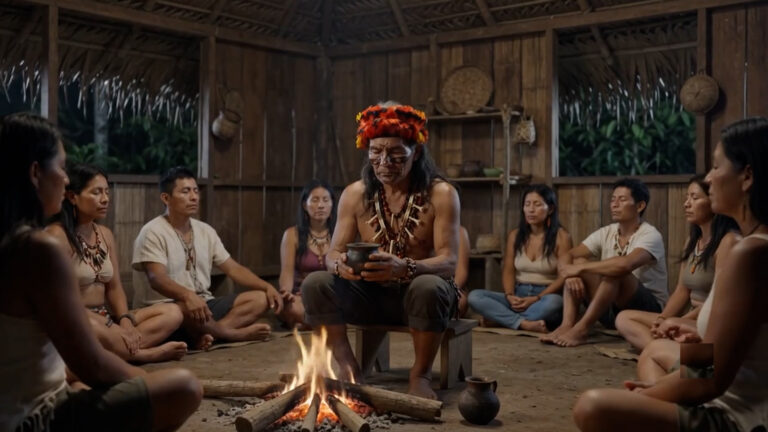
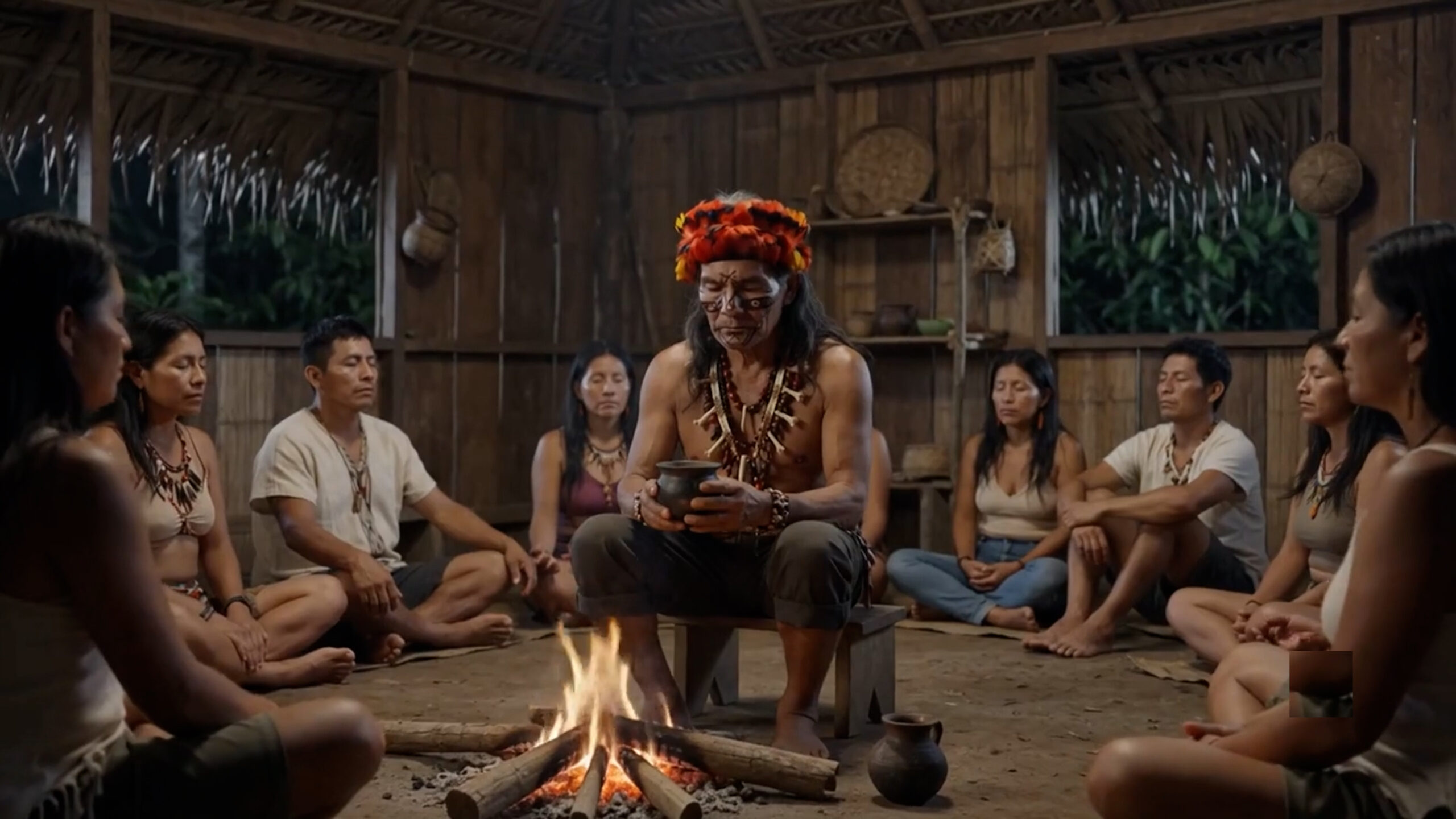
The shaman, or Uwishin, drinks Natem and spends some time alone. In Ruyman’s account, this moment allows him to unite with Arutam, the creator, and become a channel through which that presence can flow.
Here, one of the most powerful images in his explanation emerges: the “beast,” the inner animal that every person carries within and that may be weakened, asleep, or disconnected from its strength.
The shaman’s chant would act as a call. One beast recognizes another. The voice of someone connected to the source of life awakens what remains dormant in the person listening. The body may tremble, visions may appear, and the experience may take on a particular intensity.
Beyond taking this image literally, the metaphor helps us understand a central idea in the thought Ruyman seeks to convey: healing is not only about removing a symptom. It can also mean reconnecting with a deep part of oneself.
The chants, then, would be a way of remembering. Not of adding something external, but of awakening a nature that was already there.
First Life, Then Treatment
The final part of his reflection returns to Chinese medicine. Ruyman draws a distinction between two people who come seeking help.
The first is exhausted, unmotivated, lacking energy, and deeply disconnected from themselves. Under these conditions, according to his experience, acupuncture or herbal medicine may offer limited results.
The second arrives with more vital energy, perhaps after having participated in several ceremonies. They are more open, have a different relationship with spirit, and have, in Ruyman’s words, more “life” flowing through their channels.
In that case, a needle or a few medicinal plants can produce a much more meaningful response. The therapeutic tool remains important, but it comes after another condition considered essential: having energy to work with.
The idea summarizes much of his personal journey. He began as a Chinese medicine practitioner and felt there was something his tools could not fully explain. It was his encounter with Shuar shamanism, he says, that “saved” his profession and made him a better helper to others.
An Invitation to Think About Health Differently
Ruyman’s testimony proposes, above all, a transformation of the question. Instead of beginning with “What illness do I have?”, he invites us to ask, “What is my relationship with life?”
From the perspective he conveys, health is not simply the absence of illness. It is vitality, joy, the ability to adapt, connection with one’s surroundings, and contact with a spiritual dimension. Illness, by contrast, emerges when that relationship weakens.
These ideas belong to a specific tradition and must be understood within that cultural framework. The testimony does not seek to replace Western medical diagnoses or treatments, nor does it offer a universal medical explanation. Its value lies in showing that there are other ways of naming suffering, health, and recovery.
Perhaps that is why the question “Does the tiger get sick?” is so powerful. Not because it has a literal answer, but because it forces us to look again at what we take for granted.
Perhaps the lesson is not that we should live like animals, nor that every illness can be resolved by recovering some supposedly lost energy. The invitation is deeper: to ask how much of our lives unfolds disconnected from our bodies, from nature, from our instincts, from others, and from what each culture recognizes as sacred.
Watch the full talk: